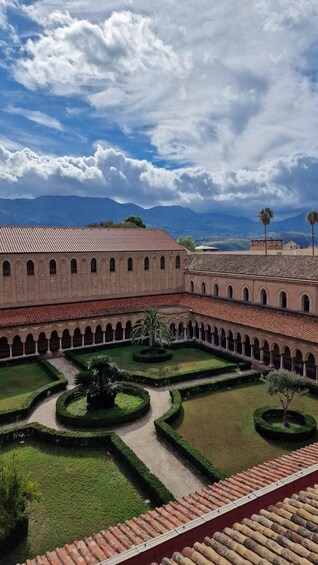
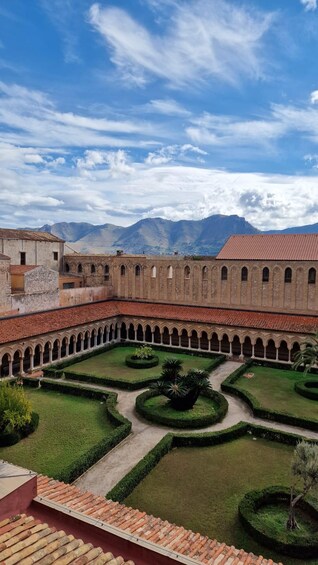
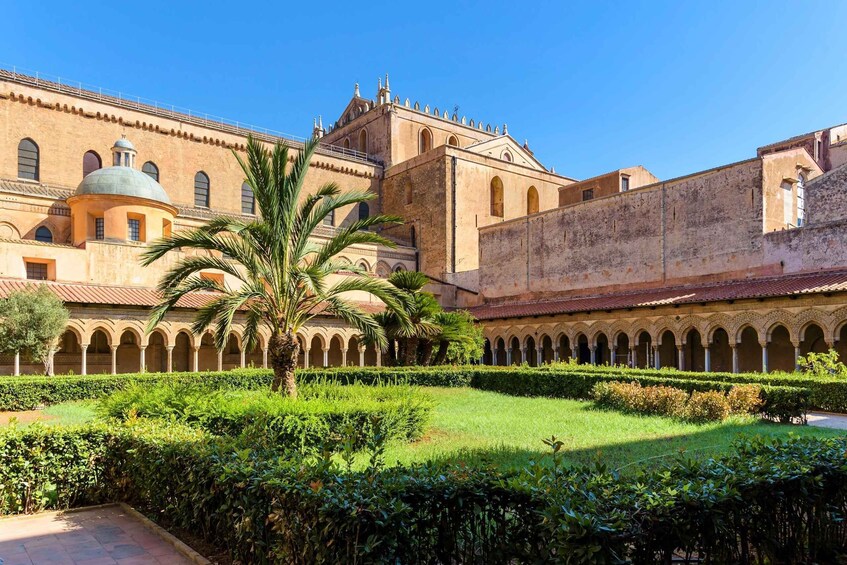
The Cloister belonging to the complex of the Benedictine abbey of S. Maria la Nuova, founded in 1174 at the behest of the Norman king William II, serves as the pivot of the entire abbey complex that develops around it and represents a splendid example of Byzantine architecture.
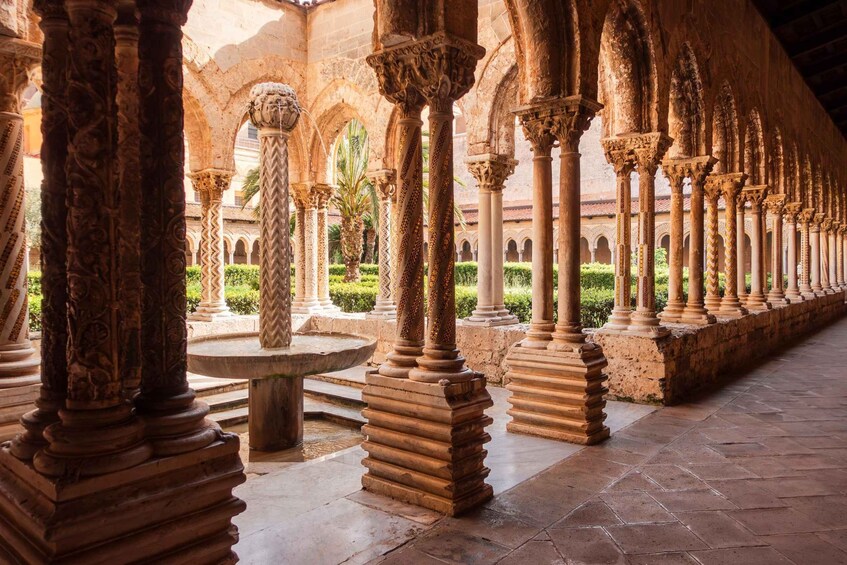
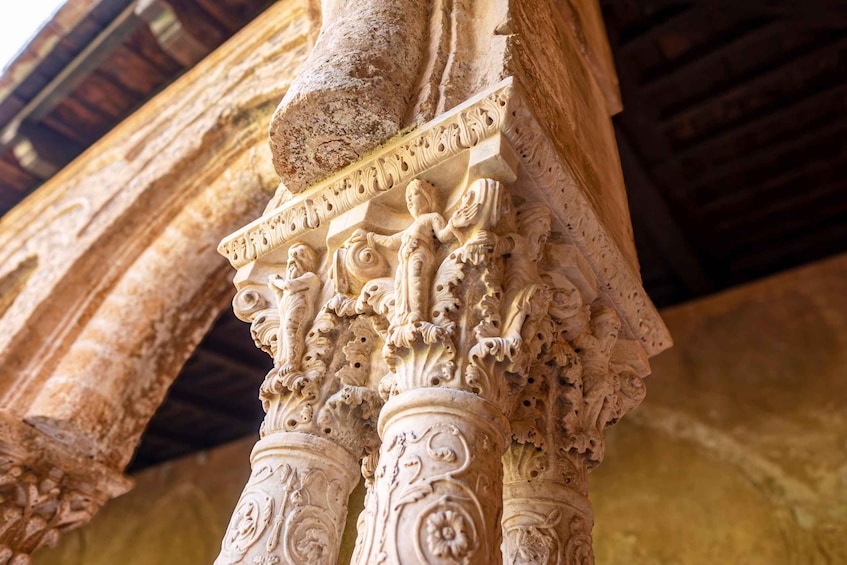
It is a purely Romanesque construction, square in plan, 47 metres per side, with a portico of pointed arches with a double archivolt on paired columns, which display alternating ornamentation, some carved with arabesques, others with mosaic inlays; the decoration of the capitals is likewise rich and varied, featuring themes tied to the religious iconography of the Old and New Testaments, animals drawn from the medieval bestiary and from Middle Eastern tradition, and phytomorphic (plant-form) motifs. In the southern corner there is a quadrangular enclosure bounded by three arches per side.
At the centre is a fountain whose water springs from a richly carved column in the shape of a stylized palm trunk, with standing figures, heads and leaves in relief. The water flows out in thin jets from human and lion-like mouths.
The bases of the cloister's columns depict an extremely wide variety of motifs: stylized leaves, rosettes, lion's paws, heads of wild beasts, groups of men and animals, frogs and lizards. After a lengthy restoration, it is now also possible to admire the Benedictines' Dormitory.