Nikiski
Panduan Perjalanan
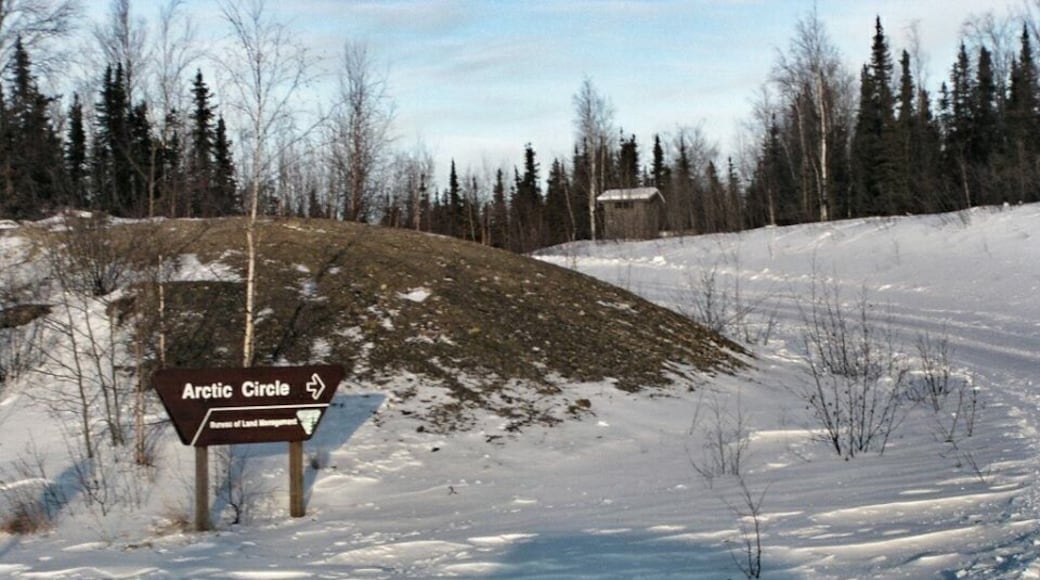
![The Arctic Circle is one of the five major circles of latitude that mark maps of the Earth. As of 16 February 2015, it runs 66°33′45.6″ north of the Equator.
The region north of this circle is known as the Arctic, and the zone just to the south is called the Northern Temperate Zone. The equivalent polar circle in the Southern Hemisphere is called the Antarctic Circle.
The Arctic Circle is the southernmost latitude in the Northern Hemisphere at which the sun can remain continuously above or below the horizon for 24 hours (at the June solstice and December solstice respectively). North of the Arctic Circle, the sun is above the horizon for 24 continuous hours at least once per year (and therefore visible at midnight) and below the horizon for 24 continuous hours at least once per year (and therefore not visible at noon). On the Arctic Circle those events occur, in principle, exactly once per year, at the June and December solstices, respectively. However, in practice, because of atmospheric refraction and mirages, and because the sun appears as a disk and not a point, part of the midnight sun may be seen on the night of the northern summer solstice up to about 50′ (90 km (56 mi)) south of the Arctic Circle; similarly, on the day of the northern winter solstice, part of the sun may be seen up to about 50′ north of the Arctic Circle. That is true at sea level; those limits increase with elevation above sea level, although in mountainous regions there is often no direct view of the true horizon.
The position of the Arctic Circle is not fixed. It directly depends on the Earth's axial tilt, which fluctuates within a margin of 2° over a 40,000-year period,[2] notably due to tidal forces resulting from the orbit of the Moon. The Arctic Circle is currently drifting northwards at a speed of about 15 m (49 ft) per year; see Circle of latitude for more information.
#snow](https://images.trvl-media.com/place/6140564/a9f9449e-bab4-40a6-a9a1-5356b0cc2aa8.jpg?impolicy=fcrop&w=1040&h=580&q=mediumHigh)
![The Arctic Circle is one of the five major circles of latitude that mark maps of the Earth. As of 16 February 2015, it runs 66°33′45.6″ north of the Equator.
The region north of this circle is known as the Arctic, and the zone just to the south is called the Northern Temperate Zone. The equivalent polar circle in the Southern Hemisphere is called the Antarctic Circle.
The Arctic Circle is the southernmost latitude in the Northern Hemisphere at which the sun can remain continuously above or below the horizon for 24 hours (at the June solstice and December solstice respectively). North of the Arctic Circle, the sun is above the horizon for 24 continuous hours at least once per year (and therefore visible at midnight) and below the horizon for 24 continuous hours at least once per year (and therefore not visible at noon). On the Arctic Circle those events occur, in principle, exactly once per year, at the June and December solstices, respectively. However, in practice, because of atmospheric refraction and mirages, and because the sun appears as a disk and not a point, part of the midnight sun may be seen on the night of the northern summer solstice up to about 50′ (90 km (56 mi)) south of the Arctic Circle; similarly, on the day of the northern winter solstice, part of the sun may be seen up to about 50′ north of the Arctic Circle. That is true at sea level; those limits increase with elevation above sea level, although in mountainous regions there is often no direct view of the true horizon.
The position of the Arctic Circle is not fixed. It directly depends on the Earth's axial tilt, which fluctuates within a margin of 2° over a 40,000-year period,[2] notably due to tidal forces resulting from the orbit of the Moon. The Arctic Circle is currently drifting northwards at a speed of about 15 m (49 ft) per year; see Circle of latitude for more information.
#snow](https://images.trvl-media.com/place/6140564/a9f9449e-bab4-40a6-a9a1-5356b0cc2aa8.jpg?impolicy=fcrop&w=1040&h=580&q=mediumHigh)

Kunjungi Nikiski

Best Western King Salmon Inn
Great staff! Heidi is the goddess of breakfast!
Diulas pada tanggal 15 Feb 2026

Aspen Hotel Soldotna
Old hotel no beeakfast like said in ad on exepdia staff was not helpful.
Diulas pada tanggal 1 Mar 2026

Aspen Extended Stay Suites Kenai
Clean comfortable room. Friendly staff
Diulas pada tanggal 25 Feb 2026

Alaska River Pirates Cabins
No indoor plumbing is nothing mentioned in ad. Only a construction site toilet system outside
Diulas pada tanggal 30 Jul 2025

Joy's Kenai River Cabins
Our stay was excellent. Joy and Tom were fantastic. They welcomed us and treated us as family. Joy reached out to me before our scheduled stay to keep me up to date and what to expect. She texed me when the cabin was ready and how to access the cabin and were to park. After we arrived and got settled ...
Diulas pada tanggal 1 Agu 2024
Tempat populer untuk dikunjungi

Taman Cunningham
Jelajahi aktivitas outdoor di Taman Cunningham, ruang terbuka hijau yang indah di Kenai. Jalan-jalan di sepanjang tepi sungai atau nikmati aktivitas spot memancing.

Kawasan Rekreasi North Peninsula
Jelajahi aktivitas outdoor di Kawasan Rekreasi North Peninsula, ruang terbuka hijau yang indah di Nikiski. Jelajahi titik pengamatan gunung berapi saat Anda berada di area ini.
Pusat Budaya dan Pengunjung Kenai
Nikmati tamasya ke Pusat Budaya dan Pengunjung Kenai selama Anda menginap di Kenai. Jalan-jalan di sepanjang tepi sungai area ini atau cukup nikmati restoran hidangan laut.
Challenger Learning Center
Anda dapat menghabiskan waktu mengunjungi pameran di Challenger Learning Center selama perjalanan Anda ke Kenai. Jalan-jalan di sekitar tepi sungai area ini, atau nikmati aktivitas spot memancing.
Kenai River Flats
Jelajahi aktivitas outdoor di Kenai River Flats, ruang terbuka hijau yang indah di Kenai. Jalan-jalan di sepanjang tepi sungai atau kunjungi gereja saat Anda berada di area ini.
Captain Cook State Recreation Area
Anda dapat meluangkan waktu untuk mengunjungi Captain Cook State Recreation Area selama perjalanan Anda ke Kenai. Jalan-jalan di sepanjang tepi sungai atau jelajahi titik pengamatan gunung berapi area ini.