Pusat Kota Solo

Solo

At the museum no photos are allowed which is really unfortunate as it was well worth the visit and the guided tour is definitely not to be missed. In the museum there are even Batik made from the Dutch era which depicts stories like Little Red Riding Hood and Snow White!

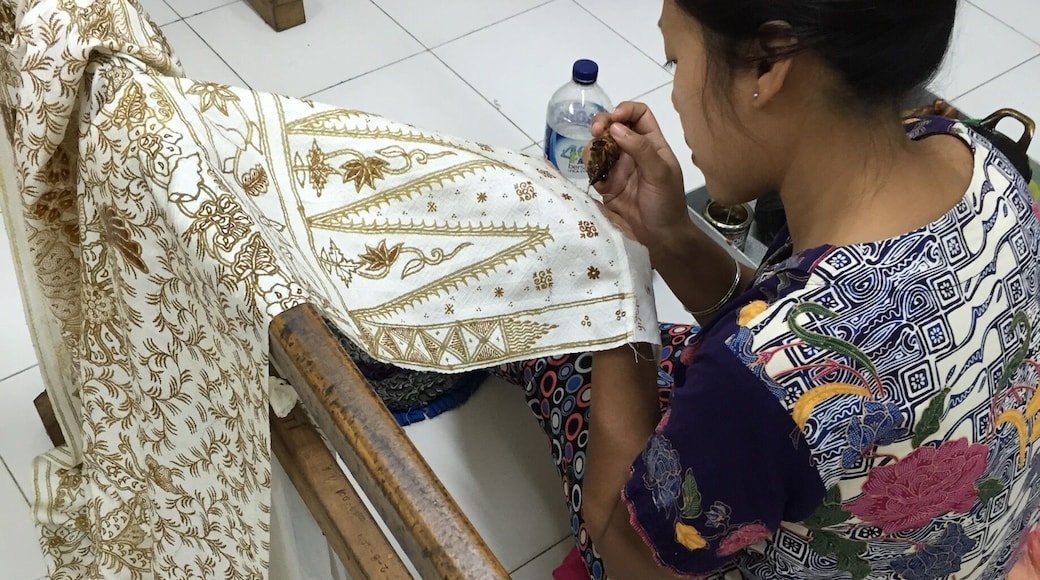
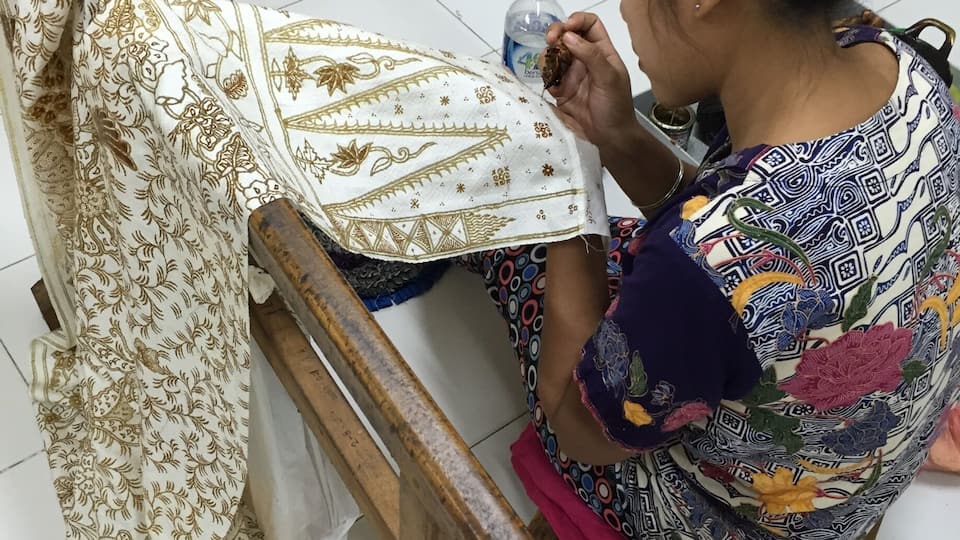
I enjoyed the tour v much and at the end of the tour we were brought to this room where the artisan were working on hand drawn batik.

Below is an excerpt from Wikipedia for anyone interested in learning more about the process of batik making.

Firstly, a cloth is washed, soaked and beaten with a large mallet. Patterns are drawn with pencil and later redrawn using hot wax, usually made from a mixture of paraffin or bees wax, sometimes mixed with plant resins, which functions as a dye-resist. The wax can be applied with a variety of tools. A pen-like instrument called a canting (IPA: [tʃantiŋ], sometimes spelled with old Dutch orthography tjanting) is the most common. A canting is made from a small copper reservoir with a spout on a wooden handle. The reservoir holds the resist which flows through the spout, creating dots and lines as it moves. For larger patterns, a stiff brush may be used. Alternatively, a copper block stamp called a cap (IPA: [tʃap]; old spelling tjap) is used to cover large areas more efficiently.

After the cloth is dry, the resist is removed by scraping or boiling the cloth. The areas treated with resist keep their original color; when the resist is removed the contrast between the dyed and undyed areas forms the pattern. This process is repeated as many times as the number of colors desired.

The most traditional type of batik, called batik tulis (written batik), is drawn using only the canting. The cloth need to be drawn on both sides and dipped in a dye bath three to four times. The whole process may take up to a year; it yields considerably finer patterns than stamped batik.

Source: Wikipedia
At the museum no photos are allowed which is really unfortunate as it was well worth the visit and the guided tour is definitely not to be missed. In the museum there are even Batik made from the Dutch era which depicts stories like Little Red Riding Hood and Snow White!

I enjoyed the tour v much and at the end of the tour we were brought to this room where the artisan were working on hand drawn batik.

Below is an excerpt from Wikipedia for anyone interested in learning more about the process of batik making.

Firstly, a cloth is washed, soaked and beaten with a large mallet. Patterns are drawn with pencil and later redrawn using hot wax, usually made from a mixture of paraffin or bees wax, sometimes mixed with plant resins, which functions as a dye-resist. The wax can be applied with a variety of tools. A pen-like instrument called a canting (IPA: [tʃantiŋ], sometimes spelled with old Dutch orthography tjanting) is the most common. A canting is made from a small copper reservoir with a spout on a wooden handle. The reservoir holds the resist which flows through the spout, creating dots and lines as it moves. For larger patterns, a stiff brush may be used. Alternatively, a copper block stamp called a cap (IPA: [tʃap]; old spelling tjap) is used to cover large areas more efficiently.

After the cloth is dry, the resist is removed by scraping or boiling the cloth. The areas treated with resist keep their original color; when the resist is removed the contrast between the dyed and undyed areas forms the pattern. This process is repeated as many times as the number of colors desired.

The most traditional type of batik, called batik tulis (written batik), is drawn using only the canting. The cloth need to be drawn on both sides and dipped in a dye bath three to four times. The whole process may take up to a year; it yields considerably finer patterns than stamped batik.

Source: Wikipedia

Tempat populer untuk dikunjungi


Penawaran Hotel di Pusat Kota Solo

The Royal Surakarta Heritage - Handwritten Collection

The Royal Surakarta Heritage - Handwritten Collection

5 out of 5
Jalan Slamet Riyadi No. 06 Surakarta Central Java
Harga Rp513.223 per malam dari 3 Mar hingga 4 Mar
Rp513.223
total Rp620.999
3 Mar - 4 Mar
termasuk pajak & biaya lainnya
Menginaplah di hotel mewah ini di Solo. Nikmati WiFi gratis, parkir gratis, dan spa layanan lengkap. Objek wisata populer seperti Masjid Agung Surakarta dan ...
8,2/10 Very Good! (168 ulasan)
Lokasi hotel strategis di tengah kota, design sangat unik berkonsep Jawa. Beberapa kali menginap disini, selalu menghadapi kondisi ac kamar yang tidak optimal dan sdh dicek namun tetap tidak bs dingin. Pemeliharaan dan perawatan perlu ditingkatkan supaya sesuai dg standar Accor intl

Diulas pada tanggal 22 Jun 2025

The Royal Surakarta Heritage - Handwritten Collection
Novotel Solo

Novotel Solo

4 out of 5
Jalan Slamet Riyadi 272 Surakarta Central Java
Harga Rp512.809 per malam dari 13 Mar hingga 14 Mar
Rp512.809
total Rp620.499
13 Mar - 14 Mar
termasuk pajak & biaya lainnya
Menginaplah di hotel spa ini di Solo. Nikmati WiFi gratis, parkir gratis, dan 2 kolam renang outdoor. Objek wisata populer seperti Museum Batik Danar Hadi dan ...
8,2/10 Very Good! (114 ulasan)
Bagus untuk mampir semalam
kamar executive di premier floor, tp tidak ada bathtub.

Diulas pada tanggal 4 Jan 2023

Novotel Solo
ibis Styles Solo

ibis Styles Solo

3 out of 5
Jalan Gajah Mada 23 Surakarta Central Java
Harga Rp365.289 per malam dari 13 Mar hingga 14 Mar
Rp365.289
total Rp442.000
13 Mar - 14 Mar
termasuk pajak & biaya lainnya
Menginaplah di hotel spa ini di Solo. Nikmati WiFi gratis, parkir gratis, dan 2 kolam renang outdoor. Objek wisata populer seperti Museum Radya Pustaka dan Museum ...
ibis Styles Solo
FIM by Zigna

FIM by Zigna

3 out of 5
31 Jl. Yosodipuro Surakarta Jawa Tengah
Harga Rp429.752 per malam dari 9 Mar hingga 10 Mar
Rp429.752
total Rp520.000
9 Mar - 10 Mar
termasuk pajak & biaya lainnya
Menginaplah di hotel spa ini di Solo. Nikmati WiFi gratis, parkir gratis, dan spa layanan lengkap. Objek wisata populer seperti Nakamura Klinik dan Istana Mangkunegaran ...
9,4/10 Exceptional! (6 ulasan)
Ok

Diulas pada tanggal 14 Jul 2023

FIM by Zigna
Comfort Centre Residence Solo

Comfort Centre Residence Solo

2 out of 5
Jalan RM. Said Surakarta Jawa Tengah
Harga Rp268.699 per malam dari 1 Mar hingga 2 Mar
Rp268.699
total Rp325.126
1 Mar - 2 Mar
termasuk pajak & biaya lainnya
Menginaplah di hotel ini di Solo. Nikmati WiFi gratis, parkir gratis, dan resepsionis 24 jam. Objek wisata populer seperti Nakamura Klinik dan Istana Mangkunegaran ...
Comfort Centre Residence Solo
Loji Hotel Solo by Wstay

Loji Hotel Solo by Wstay

3 out of 5
Jl. Hasanudin 134, Surakarta Surakarta Central Java
Harga Rp231.405 per malam dari 27 Feb hingga 28 Feb
Rp231.405
total Rp280.001
27 Feb - 28 Feb
termasuk pajak & biaya lainnya
Menginaplah di hotel spa ini di Solo. Nikmati WiFi gratis, spa layanan lengkap, dan sarapan (biaya tambahan). Objek wisata populer seperti Nakamura Klinik dan ...
Loji Hotel Solo by Wstay
Harga per malam terendah yang ditemukan dalam 24 jam terakhir berdasarkan pencarian 1 malam untuk 2 tamu dewasa. Harga dan ketersediaan dapat berubah sewaktu-waktu. Ketentuan tambahan dapat berlaku.

Pemukiman lain di Pusat Kota Solo

At the museum no photos are allowed which is really unfortunate as it was well worth the visit and the guided tour is definitely not to be missed. In the museum there are even Batik made from the Dutch era which depicts stories like Little Red Riding Hood and Snow White!

I enjoyed the tour v much and at the end of the tour we were brought to this room where the artisan were working on hand drawn batik.

Below is an excerpt from Wikipedia for anyone interested in learning more about the process of batik making.

Firstly, a cloth is washed, soaked and beaten with a large mallet. Patterns are drawn with pencil and later redrawn using hot wax, usually made from a mixture of paraffin or bees wax, sometimes mixed with plant resins, which functions as a dye-resist. The wax can be applied with a variety of tools. A pen-like instrument called a canting (IPA: [tʃantiŋ], sometimes spelled with old Dutch orthography tjanting) is the most common. A canting is made from a small copper reservoir with a spout on a wooden handle. The reservoir holds the resist which flows through the spout, creating dots and lines as it moves. For larger patterns, a stiff brush may be used. Alternatively, a copper block stamp called a cap (IPA: [tʃap]; old spelling tjap) is used to cover large areas more efficiently.

After the cloth is dry, the resist is removed by scraping or boiling the cloth. The areas treated with resist keep their original color; when the resist is removed the contrast between the dyed and undyed areas forms the pattern. This process is repeated as many times as the number of colors desired.

The most traditional type of batik, called batik tulis

Banjarsari

4/5(2 ulasan area)

Jelajahi sejumlah tempat menarik seperti Solo Paragon Lifestyle Mall dan Taman Kota Balekambang saat Anda berkunjung ke Banjarsari.

Banjarsari


Pusat Kota Solo